Oil Prices are again reacting to geopolitics and demand signals as February 2026 unfolds. Crude futures recently climbed on renewed U.S.-Iran tensions and shipping warnings near Iranian waters, tightening perceived supply risk. Brent crude closed near $69.04 per barrel, while Nymex crude settled around $64.36 per barrel, reflecting a modest geopolitical premium.
At the same time, China’s consumption outlook remains uncertain, creating a delicate balance between bullish supply fears and softer demand expectations. Recent de-escalation headlines briefly pushed crude lower, highlighting how quickly sentiment shifts in today’s energy market.
Advertisement
Geopolitical Risk Premium Returns to Oil Prices
US-Iran tensions tighten perceived supply
Oil Prices strengthened after U.S. warnings to vessels near Iran revived disruption fears across key shipping routes. Traders quickly priced in risk, lifting Brent toward the high-$60 range despite stable global inventories.
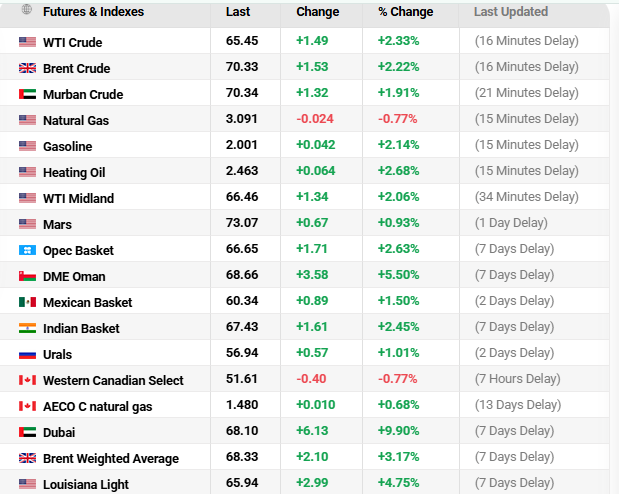
However, the rally proved fragile. Diplomatic easing between Washington and Tehran later pressured crude and precious metals, showing that geopolitical premiums can fade quickly without real supply loss.
For investors, this confirms that short-term Oil Prices remain headline-driven rather than fundamentally constrained.
China Demand Signals Keep the Outlook Uncertain
Consumption trends shape medium-term direction
China remains the single most important demand driver for global crude. Weak industrial momentum and energy transition trends continue to cloud long-term consumption visibility.
At the same time, mixed global signals complicate forecasts. Warmer weather reduced natural-gas demand while crude stayed supported by geopolitics, creating divergence across energy commodities. This shows that Oil Prices may struggle to sustain rallies unless Chinese demand clearly accelerates.
Market Volatility Reflects Policy and Supply Headlines
Political messaging quickly moves to crude
Oil recently fell about 4 percent after U.S. policy commentary reduced fears of tighter Iranian supply, ending a five-day rally.
Such rapid reversals highlight a structurally volatile market where sentiment, sanctions, and diplomacy dominate pricing more than inventories. Looking ahead, investors should expect continued swings in Oil Prices as geopolitical narratives evolve faster than physical supply.
Recent Updates in the Oil Market
- Brent crude traded near $69.04, while Nymex crude settled around $64.36 amid renewed Iran-related risks.
- Diplomatic easing between the United States and Iran recently pushed crude and bullion lower.
- Oil dropped roughly 4 percent after U.S. remarks reduced concerns about Iranian supply disruption.
- Natural-gas prices weakened to about $3.138 per MMBtu due to mild-weather forecasts, diverging from crude strength.
Overall, the market remains balanced between geopolitical risk and uncertain global demand.
Market Sentiment and Social Signals
Discussion among traders highlights commodities’ renewed relevance in 2026 portfolios, especially with gold holding above $5,000 and crude reacting to geopolitical headlines.
A representative discussion can be viewed here:
Sentiment therefore leans cautiously bullish but highly reactive to news flow.
Conclusion
Oil Prices in early 2026 sit at the intersection of geopolitics and demand uncertainty. Renewed U.S.-Iran tensions have lifted crude toward the upper-$60 range, yet diplomatic shifts and weak consumption signals quickly reverse gains.
China’s demand trajectory remains the decisive long-term variable, while short-term moves stay headline-driven. For investors, this environment favors tactical positioning, strict risk management, and close monitoring of geopolitical developments.
Sustained upside in Oil Prices will likely require both stable geopolitics and clearer global demand growth.
Advertisement
Frequently Asked Questions (FAQs)
Oil Prices are rising mainly due to renewed U.S.-Iran tensions and fears of supply disruption across key shipping routes.
Brent crude recently traded near $69 per barrel, reflecting a modest geopolitical risk premium.
China drives global oil demand, so weak consumption or energy transition trends can limit sustained price rallies.
Prices react quickly to political headlines, sanctions, and diplomacy rather than purely physical supply changes.
Yes. Strong gold prices and geopolitical uncertainty are pushing investors to reconsider commodity exposure.
Disclaimer:
The content shared by Meyka AI PTY LTD is solely for research and informational purposes. Meyka is not a financial advisory service, and the information provided should not be considered investment or trading advice.
Advertisement
What brings you to Meyka?
Pick what interests you most and we will get you started.
I'm here to read news
Find more articles like this one
I'm here to research stocks
Ask our AI about any stock
I'm here to track my Portfolio
Get daily updates and alerts (coming March 2026)